| Subject isolation |
BF (Body Floating) |
Number
of channels
|
0 to 136 monopolar active electrodes + 6 bipolar auxiliary sensors |
| Output sample-rate (down-sampling available in software) |
16384
Hz |
| Bandwidth
(-3dB): |
DC – 5.4 kHz, 0.002 dB ripple in passband |
| Low-pass
response |
140 tap FIR filter, -65 dB @ 8 kHz (Nyquist frequency) |
| High-pass
response |
fully
DC coupled |
| Digitalization: |
24 bit SAR converter with 8x oversampling and integrated decimation filter, one converter per channel, synchronous sampling |
| Sampling
skew and jitter: |
<
1 ns |
| Sample rate accuracy |
0.8 Hz |
| Quantization-resolution |
LSB
= 31.25 nV, guaranteed no missing codes |
| Gain accuracy: |
0,1
% |
| Anti aliasing
filter |
1st order analog filter, -3dB at 7.8 kHz |
| Total
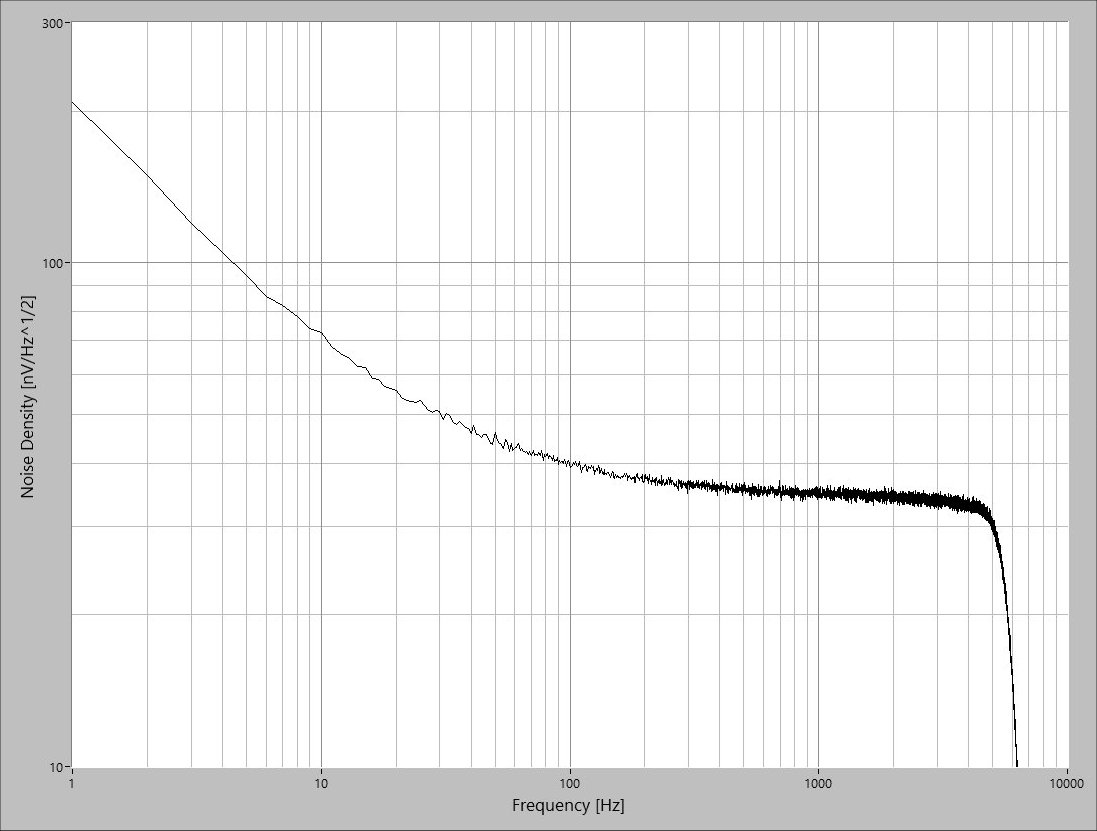
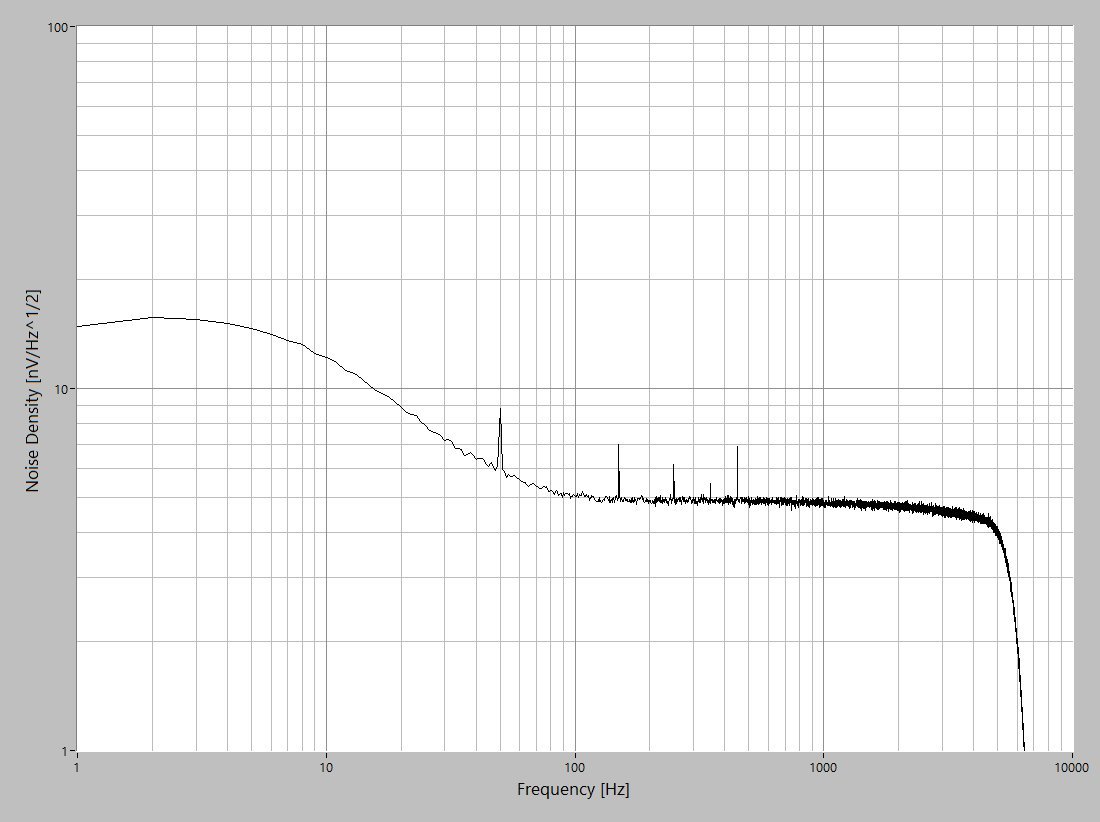
input noise (Ze < 10 kOhm):, full bandwidth |
2.8 uVRMS (approx. 15 uVpk-pk), see Fig. 1, noise spectrum |
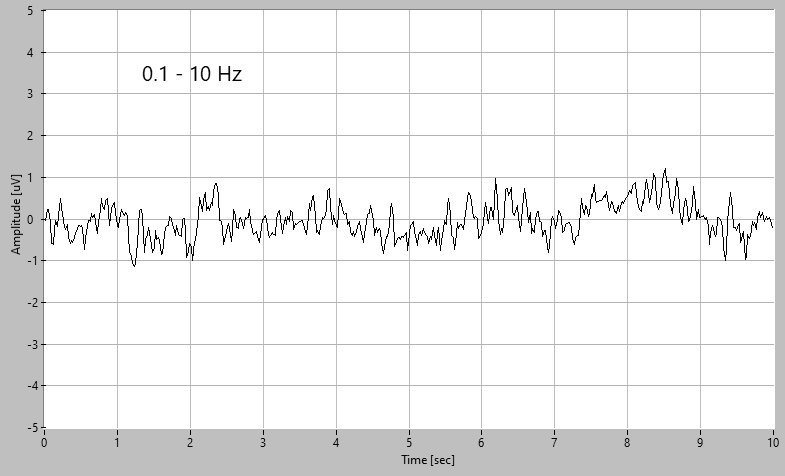
| 1/f noise (Ze < 100 kOhm), 0.1 - 10Hz |
2 uVpk-pk , see Fig. 2, pink noise plot |
| Amplifier/input
current noise: |
<
1 pArms |
| Input
bias current: |
<
100 pA per channel |
| Input
impedance Active Electrode |
600
MOhm @ 50 Hz (1012 Ohm // 5 pF) |
| DC offset: |
<
2 mV |
| Input
range |
+200
mV to -200 mV |
| Intermodulation distortion, test signals: 2990 and 3010 Hz |
<
0.01 % |
| Channel
separation |
>
100 dB |
| Common
Mode Rejection Ratio |
>
100 dB @ 50 Hz |
| Isolation
Mode Rejection Ratio |
>
160 dB @ 50 Hz |
| Power
Consumption |
0.5 Watt (6 channels) to 1 Watt (142 channels) |
| Battery
capacity, standard battery |
4000 mAh, 3.7 V Li-ion 18650 type |
| Battery
life on standard battery |
10 hours (142 channels) to 20 hours (6 channels) |
| Leakage
current, normal operation: |
<
1 uA rms. |
| Leakage
current, single fault |
<
40 uArms |
| Trigger
inputs: |
16
inputs on optical receiver (isolated from subject section) , TTL level |
| Trigger
outputs: |
12
outputs on optical receiver (isolated from subject section) , TTL level |
| Computer interface: |
USB2.0, Windows or Linux |
| Size of
front-end, including battery-box (H x W x D) |
162 x 149 x 62 mm |
| Weight of AD-box, including battery |
0.8
kg |
| Environment: Indoor use |
Temperature: +10°C to +40°C
Humidity: 30 to 75%, non condensing
Pressure: 700 hPa to 1060 hPa |
| Warranty |
3
years |
| Conformity |
EN61326 (EMC), EN60601-1 (safety) |